 |
 |
 |
| |
|
El Trapiche Tour
|
|
| |
|
Click for Printable Version
|
|
| |
|
|
|
| |
|
|
|
| |
|
|
| |
El Trapiche Tour
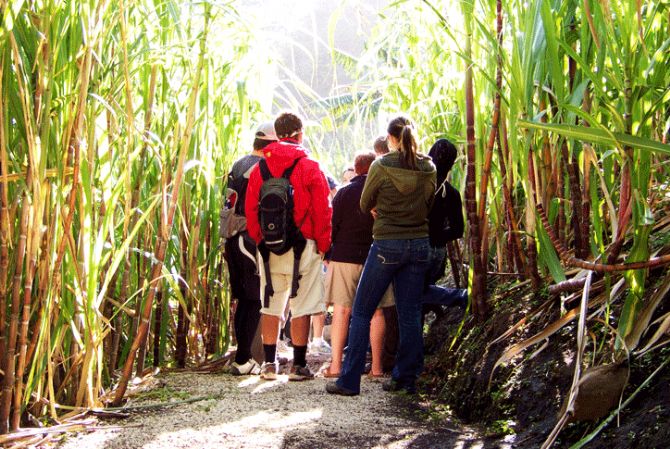
El Trapiche tour, is a Costa Rican Family project that offers visitors a two hour long guided tour. We begin with a walk on our farm where our guests will learn about the production of sugarcane, coffee, and the traditional ways of cultivating bananas, arracache (a local legume), avocado, macadamia nuts as well as other products. Also one can observe our Tilapia fish project and a small-forested area where it is possible to see various flora and fauna of the Monteverde zone.
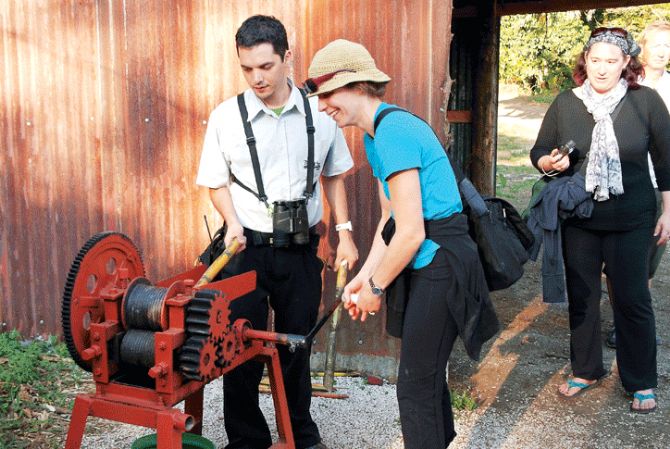
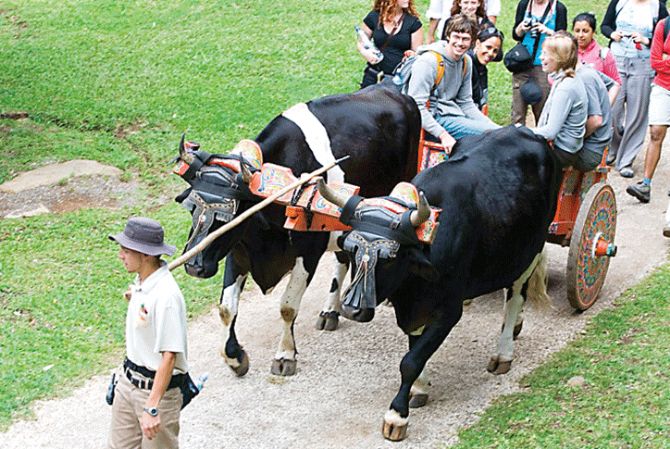
During the tour of the farm, our visitors will have the opportunity to collect coffee, transport it to the grinding machines and see how the delicious Monteverde coffee is made. Also on our farm there are oxen with a traditional cart awaiting to transport visitors to the sugarcane mill where we will demonstrate the process of making brown sugar and all the other types of products made from sugarcane.
One can also enjoy a representation of the extraction of guaro, a Costa Rican alcohol made from sugarcane. To end this eventful tour our guests can enjoy “picadillo de arracache”, a traditional vegetable hash, accompanied by a cup of coffee or lemonade.
El Trapiche Tour of Monteverde
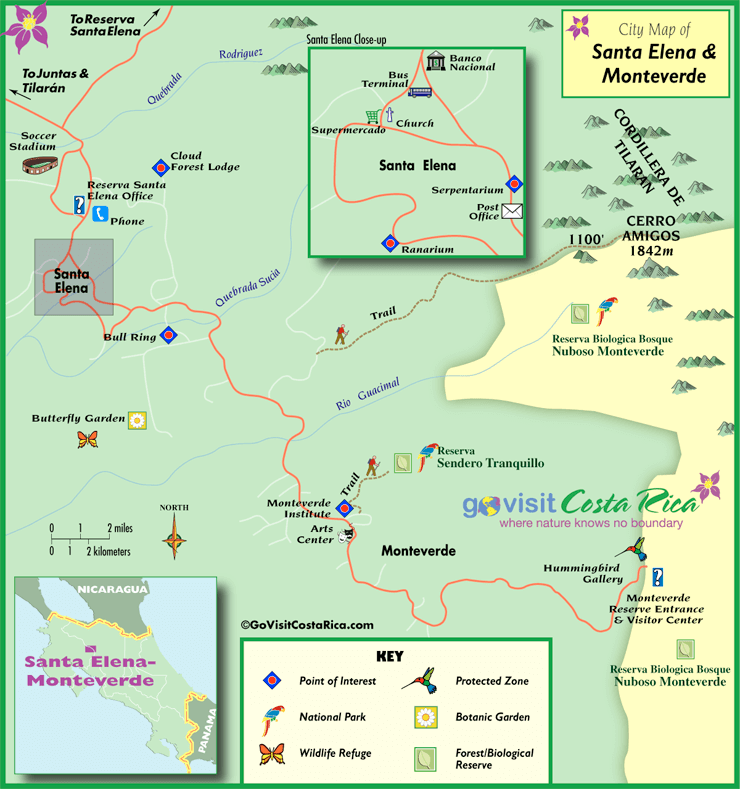
El Trapiche sugarcane mill machines were brought to Monteverde from San Ramon de Alejuela in 1948 by Iginio Santamaria. The machines were transported for approximately 15 days by oxen to the area that we now know as Santa Elena. It was there, where they were installed and began their work as a sugar cane mill, El Trapiche.
Later in 1961 one of Juan Santamaria Campos’ sons formed a company with Ricardo Arce and brought a sugarcane mill with a diesel motor to the site. They worked for 10 years after which time Señor Juan Santamaria Campos continued the work of producing sugar on his own with the help of his family, which consisted of his wife, and their five daughters and six sons.
At this time the sugar cane was brought from neighboring farms for preparation of the sugarcane. At the end of the process the produced sugar was divided up between the owner of the sugarcane mill and the owner of the farm.
The work of processing the cane began the day before with the cutting of the sugarcane and transporting it to the El Trapiche, sugar-processing machines. The following day grinding of the cane began at 3 a.m and continued until approximately 10 am. With this process 20 hundredweights were produced and then transported by horseback to the community of San Luis where it was sold for the price of 15 colones per hundredweight.
After a while the work of El Trapiche was halted and abandoned until 1989 when Juan de Dios Santamaria Hidalgo and his family took over El Trapiche and started up operation again. Then in 2005 when the family opened the doors of El Trapiche to tourism, it was no longer a place of large amounts of production of sugarcane but rather a place where they can show visitors how the Costa Rican ancestors processed and produced the sugarcane with their educational and cultural tour.
Today this is what the family still strives to show tourists, a tour where one can appreciate a little piece traditional Costa Rican life. We have accomplished this goal with the help of local Monteverde hotels and popular attractions in the area such as the canopy tour, suspension bridge tour, and the Cloud Forest Reserve of Monteverde as well as others who have made it possible for one family to demonstrate a new type of tourist attraction to the Monteverde zone.
|
|
| |
|
|
| |
Key Features
-
Two Hour Long Guided Tour in Monteverde
-
Costa Rican Family owned and operated
-
Learn about:
-
The Production of Sugarcane
-
The Production of Coffee
-
The Cultivation of Bananas
-
The Cultivation of Arracache (a local legume)
-
The Cultivation of Avocado
-
The Cultivation of Macadamia Nuts, etc.
-
The Tilapia Fish Project
-
Flora and Fauna of Monteverde zone
|
|
|
|
| |
|
|
| |
Sugarcane in Costa Rica
Sugarcane is a poacea plant that originated in Polynesia and its presence was reported in China and India in the year 800 B.C. Via the invasions of Persia, Egypt, The coasts of Africa and the Mediterranean sugarcane and other products were transported until eventually arriving in Spain. On his second trip to the Americas, Christopher Columbus, brought pieces of sugarcane that were then planted in Santo Domingo. By the 16th century sugar was an important commercial product between Europe and the productive regions of Brazil, Cuba and Mexico.
In 1530 sugarcane was brought to Costa Rica from Nicaragua by Pedrarias Davilas, who introduced it to the Ujarras Valley in Cartago. During the 18th century the production of sugarcane was based on small plots of land run by individual families for their own consumption. After 1950 was when little by little the production of sugarcane became more technological and more efficient.
Coffee in Costa Rica
The year 1723 is the presumed date of the arrival of coffee to the Americas when the first plants were introduced to Martinique Island. These coffee plants came from the Antilles islands and from there came the first coffee plants that were planted in Costa Rica during the middle of the 18th century.
Historically, Father Feliz Velarde is known as the first coffee cultivator in Costa Rica. In 1816 wrote in his will that he had a plot of land where he had planted coffee. According to the story, he distributed coffee seeds amongst his neighbors and encouraged them to plant them.
From 1830 to 1840 Don Mariano Montealegre was one of the principal promoters of the cultivation of coffee. In addition, two Costa Rican presidents Don Juan Mora Fernandez and Dr. Braulio Carrillo helped support the development of coffee. They noticed that the production of coffee had the capability of generating great economic growth that could benefit the Costa Rican people and with this observation coffee production in Costa Rica continued during the following years. During this time coffee was converted into a product that granted Costa Rica much economic development.
Did you know? - El Trapiche Tour
• Sugar was discovered in India in 4500 B.C. • Our ancestors were able to determine if foods were poisonous by their acidic or bitter flavor. Safer foods were usually sweet. • Sugar’s name comes from Sanskrit, in which sugarcane is called “cakara” and sugar is called “sarkura”. • Sugar came to Europe in 4th century B.C. as a result of Alexander the Great’s travels and conquests across Asia. • The Romans knew sugar as the salt of India. • During the Holy Crusades, the Arabs, who were sugar enthusiasts, were very influential in introducing sugar across the Middle East. • Egyptian chemists were the ones who perfected sugar processing and initiated its refinement. • Spanish conquistadors brought sugar to the Americas. • Although there are more than ten distinct varieties of manufactured sugar, they are all formed by the same process. Each kind of sugar has specific qualities, appearances and colors that increase their uses for specific occasions. • When a human baby is born, sweetness is its first distinguishable taste and is associated with pleasure. • The brain uses 20% of the body’s energy for its function and gets that energy only from glucose. • Except lacking water, no other nutritional deficit manifests itself more rapidly than a drop in the glucose level in the blood. • In addition to flavoring food, sugar is a preservative. Sugar also has painkilling and anti-depressive effects, fights dehydration, and provides energy.. • Sugar was recognized as a healthy and safe food by the Food and Drug Admistration (FDA) in 1986.
*Rates Subject to Change Without Notice.
|
|
| |
|
|
| |
|
|
|
 |
 |
|
 |